

Contemplating Endings
And the realization that many endings end nothing.

I’ve been working on a memoir for about 2 and a half years. I’m nearing the end of a complete draft: 80,000(ish) words, 250(ish) typed pages. The story spans a three(ish) year period of my life—the closing of one church (point A) and the creation of another completely different church (point B)—and tells stories of people living in extreme poverty in Portland, Oregon, in late-stage MAGA capitalism. As I explore the slow journey from point A to point B, I draw upon other parts of my late-middle-aged life.
The story is not yet finished, but the memoir is ending. The story has no end that I can see. And so, dear reader, I am stumped. It is time to write the last chapter, I know it is time like I know that it will rain during the Rose Festival.
I have no clue how to end this story that has no end that I can see. I’ve been getting coffee with friends to ask them how they think it ends. People say wise things about the goodness of humans, about the omnipresence of the Creator. I want that in my book’s ending. But the story is not one that ties up in a bow. The people who come to the point B church are people suffering in many ways, and my new church has not changed that. No bows allowed.
I dug out every memoir in my house that I can get my hands on. Some I know I have but I can’t find. (Where is Liar’s Club? Where is Wild? Where is The Stuff of Life by Karen Karbo? I must’ve loaned them out.)
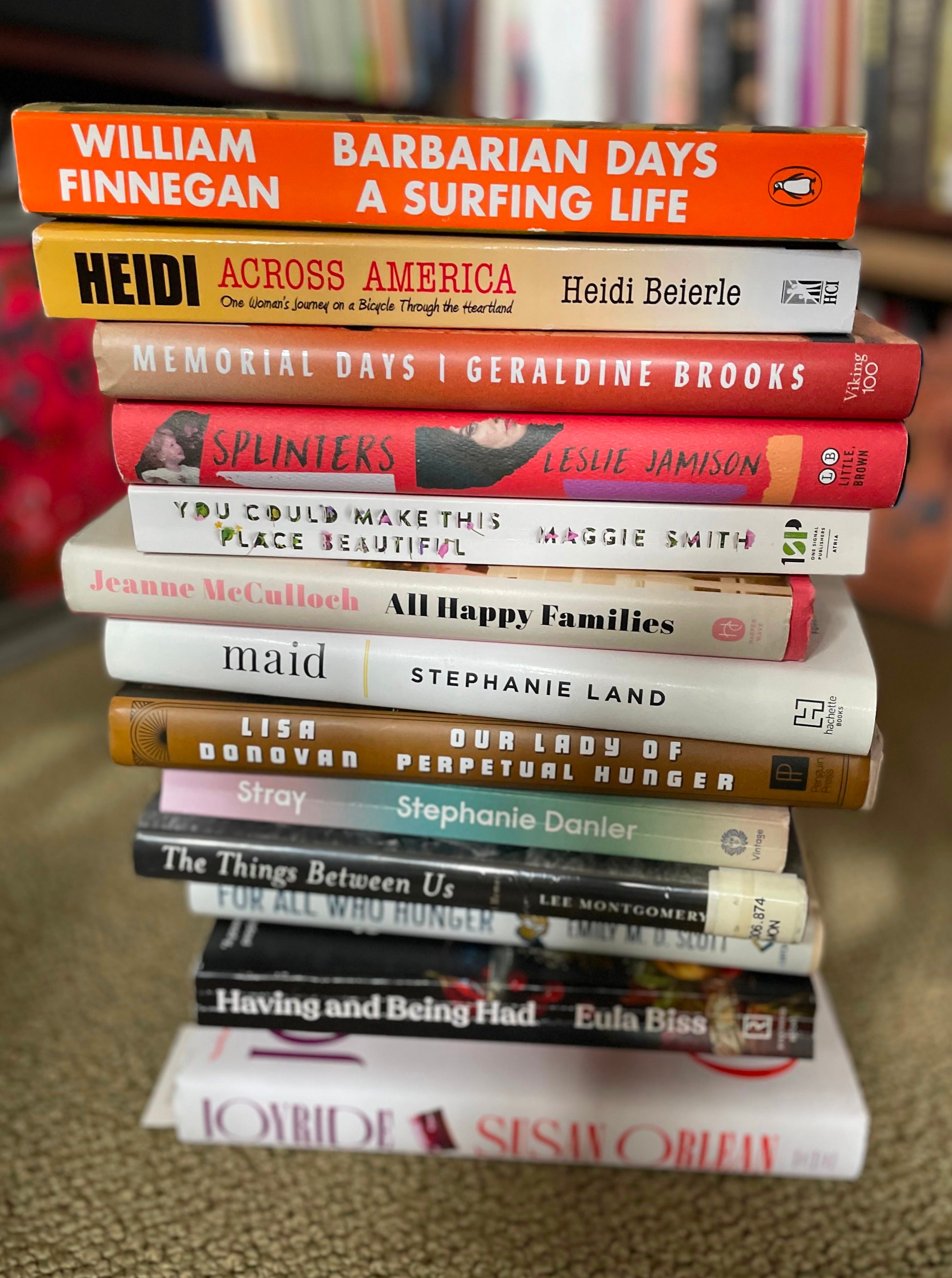
Strange as it may be for someone who only writes nonfiction (if sermons can be considered nonfiction), I mostly read fiction, so I don’t have an endless supply of memoirs on my shelves. But I made a pile—not huge because I’m mostly a library girl—on the floor of my study, between the prayer-and-collage bookshelf and the poetry-and-craft bookshelf.
I read the last few paragraphs of each. Some were the last paragraphs of books I haven’t yet read; others were the last paragraphs of books I read long ago and cannot remember. In every case, I learned something about endings.
Here’s a sampling.
Jeanne McCullough, All Happy Families:
“I took one last look back. In the few fragments of broken glass still clinging to the sills of the windows of the house, the last light of the day reflected red. When I was young, and the windows were enflamed by the setting sun, it appeared to my naively intoxicated imagination as if the house were filled to the brim with roses. As my mother would have had it, tomorrow would be a perfectly glorious day.”
Stephanie Danler, Stray:
You have to make a change, I say out loud to the canyon, the crickets, the traffic, the smog, the coyotes, and that stray cat I haven’t seen in a week. Thank you, I say to the car.
I think I’m learning how to be careful with things. By careful I don’t mean caution. I mean it literally, taken as its suffix and root. I am learning to be full of care.
Susan Orlean, Joyride:
This story here, the one I’ve just told you—it doesn’t have a tidy resolution, either. It is a river journey we’ve taken together, and I’ve done my best to point out highlights along the way. See that rock outcropping? See that broken branch? See that whirlpool, that eddy, that cresting wave? See my failures, my triumph, my heartbreaks, my joys? See my story? It will continue, off the page, into time, into a future I can’t wait to meet.
Mary Karr, Lit:
Every now and then we enter the presence of the numinous and deduce for an instant how we’re formed, in what detail the force that infuses every petal might specifically run through us, wishing only to lure us into our full potential. Usually the closest we get is when we love, or when some beloved beams back, which can galvanize you like steel and make resilient what had heretofore only been soft flesh. It can start you singing as the lion pads over to you, its jaws hinging open, its hot breath on you. Even unto death.
Eula Biss, Having and Being Had:
I regard the wheelbarrow full of fresh dirt resting above my unquiet grave. Now I’m in the hole I dug myself, I think with amusement. It feels like an accomplishment.
My story will not end as tidily as any of these examples or the endings I did not include here. I hope that it will leave a question, open up to a future like most of these. I have known all along that the story I’m trying to tell will not end tidily, if at all. Stories full of humans rarely do. And yet, because I’m me, I still want the bow. (Too bad for me.) The ending I’ll come up with? For that, dear reader, we will all need to wait.
This is such a beautiful reflection, Sara, and such an important question - how to end? I love the passage from Eula Bliss, looking up from the bottom of the hole she's dug. It's so tempting, as Karen Karbo told me when I was at the end and not sure how to do it, to just jump off the cliff. You will find your own end to this story, the one that wrestles with the fact that there is no tidy ending but you have reached Point B. Look around. Lean into your senses. What does the moment feel like? The settling into stillness when you say, "Well, here we are."